Monday, July 13, 2009

Bacteria's "Rosseta Stone" Unearthed

Read this and think deeply...

The Rosetta Stone of bacterial communication may have been found. Although they have no sensory organs, bacteria can get a good idea about what's going on in their neighborhood and communicate with each other, mainly by secreting and taking in chemicals from their surrounding environment. Even though there are millions of different kinds of bacteria with their own ways of sensing the world around them, Duke University bioengineers believe they have found a principle common to all of them.

The researchers said that a more complete understanding of communication between cells and bacteria is essential to the advancement of the new field of synthetic biology, where populations of genetically altered bacteria are "programmed" to do certain things. Such re-programmed bacterial gene circuits could see a wide variety of applications in medicine, environmental cleanup and biocomputing.

It is already known that a process known as "quorum sensing" underlies
communication between bacteria. However, each type of bacteria seems to have its
own quorum-sensing abilities, with tremendous variations, the researchers said.

"Quorum sensing is a cell-to-cell communication mechanism that enables bacteria to sense and respond to changes in the density of the bacteria in a given environment," said Anand Pai, graduate student in bioengineering at Duke's Pratt School of Engineering. "It regulates a wide variety of biological functions such as bioluminescence, virulence, nutrient foraging and cellular suicide."

The researchers found that the total volume of bacteria in relation to the volume of their environment is a key to quorum sensing, no matter what kind of microbe is involved.

"If there are only a few cells in an area, nothing will happen," Pai said. "If there are a lot of cells, the secreted chemicals are high in concentration, causing the cells to perform a specific action. We wanted to find out how these cells know when they have reached a quorum."

Pai and scientist Lingchong You, assistant professor of biomedical engineering and a member of Duke's Institute for Genome Sciences & Policy and Center for Systems Biology, have discovered what they believe is a common root among the different forms of quorum sensing. In an article in the July 2009 issue of the journal Molecular Systems Biology, they term this process "sensing potential."

- Brewskie

LCD Screens Make Good Medicine

Polyvinyl-alcohol (PVA) is a component of LCD screens which can also be used for the manufacturing of medication, and bandages. Researchers have been tyring figure out how to yank this from broken screens, or frazzled systems, and put it towards potentially life-saving endeavors. It turns out... they just did.

Researchers from The University's department of Chemistry have figured out a way to recover the chemical from LCD displays and turn it into this medicinal compound, which could be put into pills or dressings.

The research is in a paper titled "Expanding the potential for waste polyvinyl-alcohol," published in Green Chemistry.

The unique twist to this research - as if we need anything stranger than using old TVs for medicine - is that the discovery comes to us not through researchers seeing the medical use of PVA and then looking at sources for it, but rather researchers looking at what to do with e-waste, and finding a medical use for it.

Professor James Clark, director of the York Green Chemistry Centre of Excellence and one of the author's of the research, said: "With 2.5 billion liquid crystal displays already reaching the end of their life, and LCD televisions proving hugely popular with consumers, that is a huge amount of potential waste to manage.

"It is important that we find ways of recycling as many elements of LCDs as possible so we don't simply have to resort to burying and burning them."

Clark explains that even though PVA isn't a major environmental hazard, there's no sense in wasting it since it is a non-renewable resource. And because LCD waste from electrical and electronic equipment is the fastest growing waste stream in the European Union, it makes sense to find some use for LCDs other than incinerating or landfilling them.


- Brewskie

Mountaintop Removal in Appalachia: Perpetual Money Pit

Yearly coal mining in the Appalachia costs $9-$76 billion more than it brings in.

Health Costs Far Outpace Coal RevenueLooking at statistics from 2005 (the latest for which mortality rates are available) the researchers found that though coal mining brought in about $8 billion to the state coffers of Appalachian states, the costs of the shorter life-spans associated with coal mining operations were nearly $17 billion to $84.5 billion.

Coal mining areas in Appalachia were found to have nearly 11,000 more deaths each year than other places in the nation, with 2,300 of those attributable to environmental factors such as air and water pollution.


- Brewskie

Tessara Plans 500MW Solar Project

It's no Sahara solar project, but we'll take what we can get. Tessera Solar Plans 500MW Solar Thermal Power in Riverside County, California.

Tessera said it's teaming up with Optiflex Properties & Development on developing and financing the power plants, which would be located on closed landfills and undeveloped properties, said Janette Coates, a spokeswoman for Tessera.

Tessera announced the project earlier this week, about two weeks after it said it would build a 27-megawatt solar project in Texas and sell the power to CPS Energy, which is run by the city of San Antonio.

Building 500 megawatts would require about 3,500 acres, she said. Tessera and Optiflex are scouting for ideal locations in Riverside for erecting Stirling Energy Systems' SunCatcher equipment.

A SunCatcher is made up of a giant parabolic dish of mirrors (40 feet across) to concentrate the sun onto a receiver called a "power conversion unit (PCU)." Sunlight heats up the hydrogen gas in tubes in the PCU, and the gas goes through a heat exchanger to run a four-cylinder Stirling engine. The engine then drives a generator to produce electricity.

Stirling Energy Systems (SES) recently unveiled a newly designed SunCatcher that it said would be easy to mass produce and maintain than its first-generation design.

The history of Stirling engines goes back to 1816, when Robert Stirling in Scotland designed the first machine and built it two years later to pump water from a quarry.


The companies plan to start construction between 2010 and 2012.

- Brewskie

LA Shoots to be Coal-Free by 2020

On the cusp of flamboyant stardom to financial meltdown, some people squander on frivolous grandeur to pamper their bruised, and bleeding ego. "They splurge on a sports car, take a trip to Vegas, or become fashionholics," a psychologist friend once told me. Perhaps this is the state of LA: no doubt it is has good intentions, but considering the financial shape of California, the energy usage of this sprawling jungle of concrete roads and strip malls, this perhaps is somewhat viewed under the psychological prism previously described - an effort to "clean" one's sooty ego of both smog and foolish monetary dissipation. Good luck... I mean coal-free by 2020. Oh well, even if you get half-way there (there the link,)... enough with the Freudian blather.

Yesterday, Los Angeles mayor Antonio Villaraigosa announced his intention to make the city entirely coal-free by 2020, and turn to clean and renewable energy instead. Inspiring? Yes. Possible? Maybe not so much.

Villaraigosa made the assertion during his second inauguration speech--and a bold assertion it is indeed. From his speech (via Going Green):

It's now time to meet the carbon challenge. Our second goal for the next four years is to put L.A. on a path to permanently break our addiction to coal. Coal currently accounts for roughly 40% of the DWP's power portfolio. Breaking the coal habit is a long term proposition demanding a long-term commitment. It's going to require investment from ratepayers.End specifics. Well, it's a nice thought, isn't it? And I wouldn't be so cynical if there seemed like there was any clear way at all it could actually happen. That LA gets 40% of its energy from coal is a pretty significant figure, especially considering there are 4 million people in the city. As Triple Pundit points out, it's extremely infeasible that LA weans itself from coal in ten years when it has such a huge (and still growing) energy demand.

The Los Angeles Department of Water and Power provides about 7000 megawatts of power for the city, and coal makes up 40 percent of that, or 2800 MW. For some perspective, the largest solar plant in the country, the as-yet-unfinished Ivanpah Solar power plant in the Mojave Desert, will provide a mere 400 MW -- and LA shouldn't count on getting all of that.So what are we to make of Villaraigosa's proclamation? Well, it's politically well-timed, with the recent passage of the climate bill still fresh in the memory. Plus, it's pretty likely he won't have to be held accountable if the target isn't hit--not too likely he'll still be in office in 2020.

- Brewskie

What Do CNG Vehicles Get? Five Dollar Fill-Ups

(Hat Tip: Benjamin)

This is an article from last year that descries the CNG situation in Utah, one of the nation's most CNG-friendly states (link):

Troy Anderson was at the gas pump and couldn't have been happier, filling up at a rate of $5 per tank. Anderson was paying 63.8 cents per gallon equivalent for compressed natural gas, making Utah a hot market for vehicles that run on the fuel.

It's the country's cheapest rate for compressed gas, according to the Natural Gas Vehicle Coalition, and far less than the $3.56 national average price for a gallon of gasoline.

"I'm totally celebrating," crowed Anderson, a 44-year-old social worker, who picked up a used Honda Civic GX two months ago. "This is the greatest thing. I can't believe more people aren't talking about it. This is practically free."

Personal ownership of natural gas-fueled vehicles in Utah soared from practically nothing a few years ago to an estimated 5,000 vehicles today, overwhelming a growing refueling network, where compressors sometimes can't maintain enough pressure to fill tanks completely for every customer.

[...]

Utah has 91 stations, including 20 open to the public, mostly in the Salt Lake City area. The others are reserved for commercial drivers, such as school districts, bus fleets and big businesses such as a Coca-Cola distributor.

It's possible to drive the interstates between Rock Springs, Wyo., and St. George, Utah -- a distance of 477 miles -- and find 22 places to pull off and fill up.

California has more stations but prices are much higher there, the equivalent of $2.50 a gallon for gasoline.

"Utah has the cheapest prices by a big margin," said Richard Kolodziej, president of the Natural Gas Vehicle Coalition, whose members include utilities, Honda Motor Co., environmental groups and transit agencies.

Earlier this year, Oklahoma legislation introduced a bill for CNG vehicles and refueling stations, and currently, the US Congress is debating legislation to extend and double tax credits for CNG vehicles.

- Brewskie

Breaking Russia's Gas Stranglehold

In regards to an earlier post, six countries have agreed to build a US-backed gas pipeline, the Nabucco, to break Russia's gas export monopoly to Europe:

Officials from six countries gathered Monday in Turkey and signed a deal to build a U.S.-backed pipeline, aimed at breaking Russia's near-monopoly on natural gas supplies to Europe.

The proposed Nabucco pipeline would run from Turkey's eastern border, through Bulgaria, Romania and Hungary, to a key gas terminal in Baumgarten, Austria.

Germany is also a partner in the deal, which is being signed in the Turkish capital, Ankara.Russia controls the current network of pipelines that supply Europe with natural gas.

To challenge the Nabucco proposal, Russia has proposed a competing natural gas pipeline to southeastern Europe. The South Stream pipeline would pass under the Black Sea and connect with Bulgaria. Russia and Italy would each control half of that pipeline.

[...]

Gas from Azerbaijan's Shah Deniz 2 field will be a crucial component of the project. European officials have raised hopes that other gas producers, such as Iraq and Turkmenistan, also might contribute to the pipeline.

Big hurdles remain for the pipeline project named after an opera by Verdi.

Consortium members must raise billions of dollars for the Nabucco project. Construction has not begun, and gas is not projected to be pumped through until 2014.Still, industry analysts called Monday's intergovernmental agreement a significant development.

"It's one of those steps that moves Nabucco out of the possible column and into the probable column," said John Roberts, an energy security specialist with Platts.

"My own guess is roughly by the end of the year, it will be pretty clear that Nabucco will be built."


- Brewskie

Friday, July 10, 2009

Squeezing More Gasoline Out of Crude

It seems like I've been posting a lot on hydrocarbons this week. Never the less (link)...

In an effort to make gasoline production cleaner and more efficient, Rive Technology of Cambridge, MA, is developing a catalyst that can help turn a greater percentage of crude petroleum into gasoline and other usable products. The company, which is testing the catalyst in its pilot plant in South Brunswick, NJ, believes that the technology will be able to process lower-grade fossil fuels and reduce the amount of energy that goes into the refining process.

Andrew Dougherty, vice president of operations at Rive, says that the catalyst could increase the proportion of petroleum processed by as much as 7 to 9 percent. "We're going to need liquid, fossil-fuel-based transportation fuels for the foreseeable future," he says. "We help make the production of those fuels much more efficient."

The company's technology is based on zeolites--tiny pore-studded particles made of a mix of aluminum, oxygen, and silicon that are a mainstay of the petroleum and petrochemical industries. Heated and mixed in with crude petroleum, zeolites act as a catalyst, breaking apart the complex hydrocarbon molecules of crude into simpler hydrocarbons that make gasoline, diesel, kerosene, and other desirable products in the process known as fluid catalytic cracking. By making zeolites with pores larger than those in conventional ones, Rive hopes to create catalysts that handle a higher proportion of hydrocarbons.

Typically, the openings of pores in zeolites are less than a nanometer wide, which limits the range of hydrocarbon that can get into the porous catalysts. But Javier Garcia Martinez, a cofounder of Rive and now a professor at the University of Alicante, in Spain, came up with a way to control the size of the openings while working as a postdoctoral fellow at MIT's Nanostructured Materials Research Laboratory. He mixes the constituents of the zeolites in an alkaline solution, then adds a surfactant--a soaplike liquid. The surfactant makes bubbles, and the zeolites form around the bubbles. Then he burns away the surfactant, leaving behind zeolites with openings two to five nanometers wide--big enough to let in larger hydrocarbon molecules. By varying the chemistry of the surfactant, Garcia Martinez can control the size of the pore openings.

Part of improving the yield will be a result of perfecting the catalyst, which must be mixed with clay and other inert materials and spray-dried to create microspheres about 0.10 millimeters in diameter. The pilot plant is testing different combinations of materials to get the best properties. "By the end of the year, we hope to have hit upon the optimum mix of these things," says Dougherty. "We hope to be in commercial refineries in the second half of 2011." The plan is to license the recipe to commercial manufacturers of petroleum catalysts, such as BASF or W.R. Grace.

Dougherty also sees Rive's zeolites being used in hydrocracking, a refining technique that employs high-pressure hydrogen to create a low-sulfur diesel. Hydrocracking is a small market, but with the U.S. Environmental Protection Agency trying to reduce sulfur emissions, it's a growing one, he says. With its ability to choose pore size, the company might also make catalysts for processing tar sands, which contain extremely dense petroleum. Further down the road, the material might also be used to process biofuels, according to the company.


- Brewskie

Solar Built on Nanopillars

University of California at Berkeley have demonstrated another way to fabricate efficient solar cells from cheap, and flexible materials (link):

Researchers at the U.S. Department of Energy’s Lawrence Berkeley National Laboratory and the University of California at Berkeley have demonstrated a way
to fabricate efficient solar cells from low-cost and flexible materials. The new design grows optically active semiconductors in arrays of nanoscale pillars, each a single crystal, with dimensions measured in billionths of a meter.

[...]

solar cell’s basic job is to convert light energy into charge-carrying electrons and “holes” (the absence of an electron), which flow to electrodes to produce a current. Unlike a typical two-dimensional solar cell, a nanopillar array offers much more surface for collecting light. Computer simulations have indicated that, compared to flat surfaces, nanopillar semiconductor arrays should be more sensitive to light, have a greatly enhanced ability to separate electrons from holes, and be a more efficient collector of these charge carriers.

“Unfortunately, early attempts to make photovoltaic cells based on pillar-shaped semiconductors grown from the bottom up yielded disappointing results. Light-to-electricity efficiencies were less than one to two percent,” says Javey. “Epitaxial growth on single crystalline substrates was often used, which is costly. The nanopillar dimensions weren’t well controlled, pillar density and alignment was poor, and the quality of the interface between the semiconductors was poor.”

Javey devised a new, controlled way to use a method called the “vapor-liquid-solid” process to make large-scale modules of dense, highly ordered arrays of single-crystal nanopillars. Inside a quartz furnace his group grew pillars of electron-rich cadmium sulfide on aluminum foil, in which geometrically distributed pores made by anodization served as a template.

In the same furnace they submerged the nanopillars, once grown, in a thin layer of hole-rich cadmium telluride, which acted as a window to collect the light. The two materials in contact with each other form a solar cell in which the electrons flow through the nanopillars to the aluminum contact below, and the holes are conducted to thin copper-gold electrodes placed on the surface of the window above.

The efficiency of the test device was measured at six percent, which while less than the 10 to 18 percent range of mass-produced commercial cells is higher than most photovoltaic devices based on nanostructured materials – even though the nontransparent copper-gold electrodes on top of the Javey group’s test device cut its efficiency by 50 percent. In future, top contact transparency can easily be improved.

- Brewskie

Guess What OPEC's Been Doing? (Suprised?)

OPEC has stated repeatedly it prefers a target oil price of $70-80 per barrel, and has committed produciton cuts to reach that aim. Since oil's been higher the past several months, guess what OPEC is having a problem with? Historical non-compliance:

OPEC nominally still has big oil-production cuts in place, but cartel members such as Iran and Angloa—both suffering from the recession—are looking for revenue in extra barrels of crude. Compliance among OPEC’s 11 quota-bound members was down to 68% in June, after reaching 80% earlier this year, according to the International Energy Agency.

That compliance rate is par for the course, historically. But it means that since April, OPEC increased production by about 330,000 barrels a day. And additional oil has hit the market from other sources, the IEA says. Since demand is still fairly week and inventories are still bulging, that extra crude is simply feeding oil bears.


Is that a good idea to pursue when there's a already a global glut?

- Brewskie

Exxon Discovers Canadian-Sized Gas Prize

Folks... you thought shale gas was big. You've been impressed by the America's jump in gas reserves - a prelude, to be precise. You've been impressed with the size of shale fields, that we have a 100-year supply of gas, that the whole world now wants to learn from our success. Folks... this isn't going to end anytime soon.

Congratulations, Canada. The Horn River Field, it turns out, may be the best shale play in N America:

Exxon is most encouraged by the exploration of 250,000 acres it has leased in the Horn River Basin, in northern British Columbia. Mr. Cejka said results from the first four wells lead the company to conclude that each well will produce between 16 million and 18 million cubic feet of gas a day.

That's five times the size of average wells in Texas's Barnett shale and comparable to big wells in Louisiana's Haynesville shale, two major shale-gas fields that already have moved the U.S. natural-gas market from scarcity to abundance.

Though Exxon is better known as the nation's largest oil company, "We are really interested in shale gas," Mr. Cejka said, detailing the company's push into the energy-exploration business, which was once dominated by scrappy independent companies.

[...]

Other energy companies also are excited about the Horn River field. "This may be the best shale play in North America," said Michael Graham, an executive vice president at EnCana Corp., a Calgary company that already has a big Horn River presence. Mr. Graham said EnCana's latest wells are approaching Exxon's in terms of initial production.

Exxon's Mr. Cejka said that his company also has pieced together substantial leases in prospective shale-gas formations in Germany, Hungary and Poland, and is still adding acreage. Tests on two wells in Hungary, where Exxon and partners hold 400,000 acres, are expected this year. It will be the first time the shale there has been tested.

"Depending on how that goes, we'll either be patting ourselves on the back or walking away," Mr. Cejka said.

The company also plans 10 wells on 750,000 acres it holds in northern German's Lower Saxony Basin this year to better study the geology.

- Brewskie

Thursday, July 9, 2009

Recruiting for Europe's Super Grid

The European Renewables Grid Initiative is seeking to recruit additional members for a pan-European super grid:

The group was formally launched last week with a goal of promoting the adoption of regulations and policies to support the development of a pan-European super-smart grid, capable of transmitting renewable energy from remote locations such as offshore wind farms and North African solar farms, and automatically managing energy generated from distributed micro-generation technologies.

Lucile Barras, project manager at German thinktank Thema1, said that the group was looking to sign up more companies to join the founding members: WWF and NGO group Germanwatch, and grid operators Vattenfall Europe Transmission and Tennet.

"We are absolutely looking to expand the group and the initiative is open to all transmission operators, energy suppliers, renewable energy producer and green NGOs," she said.

Barras added that the goal of the new group was to lobby at a national and EU level for the wider adoption of the policy and legislative framework that will be needed to support the upgrading and expansion of existing transmission lines and the development of a pan-European super-grid.

The new group was welcomed by Antonella Battaglini, senior scientist at the Potsdam Institute for Climate Impact Research (PIK) and a leading expert in grid technologies, who argued that the roll out of a cross-border energy grid will be essential if the EU is to meet its long-term emission reduction targets.


"A clear framework for tailored investments in grid expansion will enable simultaneously large renewable expansion projects, which substantially contribute to the 2020 and 2050 targets, while stimulating the economy," she said.


- Brewskie

Pee... Power??

Perhaps we've got it all wrong... maybe beer soaked college football fans are the answer. Maybe stuffing them in the bathroom - like cattle in the walkway, connecting them nose-to-ass on their march to the feedlot - lining them up like watering statues, and having them twinkle away doomers' disamay... is our energy Independence is the answer!


I picked this one up from the Daily Drumbeat. It was too funny to pass up (link):

Urine-powered cars, homes and personal electronic devices could be available in six months with new technology developed by scientists from Ohio University.

Using a nickel-based electrode, the scientists can create large amounts of cheap hydrogen from urine that could be burned or used in fuel cells. "One cow can provide enough energy to supply hot water for 19 houses," said Gerardine Botte, a professor at Ohio University developing the technology. "Soldiers in the field could carry their own fuel."

Pee power is based on hydrogen, the most common element in the universe but one that has resisted efforts to produce, store, transport and use economically.

Storing pure hydrogen gas requires high pressure and low temperature. New
nanomaterials with high surface areas can adsorb hydrogen, but have yet to be produced on a commercial scale. Chemically binding hydrogen to other elements, like oxygen to create water, makes it easier to store and transport, but releasing the hydrogen when it's needed usually requires financially prohibitive amounts of electricity.

By attaching hydrogen to another element, nitrogen, Botte and her colleagues realized that they can store hydrogen without the exotic environmental conditions, and then release it with less electricity, 0.037 Volts instead of the 1.23 Volts needed for water.

One molecule of urea, a major component of urine, contains four atoms of hydrogen bonded to two atoms of nitrogen. Stick a special nickel electrode into a pool of urine, apply an electrical current, and hydrogen gas is released.

Botte's current prototype measures 3x3x1 inch and can produce up to 500 milliwatts of power. However, Botte and her colleagues are actively trying to commercialize several larger versions of the technology.

A fuel cell, urine-powered vehicle could theoretically travel 90 miles per gallon. A refrigerator-sized unit could produce one kilowatt of energy for about $5,000, although this price is a rough estimate, says Botte.

Bottoms' up to energy independendence!

- Brewskie

McDonalds to Open Electric Car-Charging Restaurant

Would you like your recharge supersized? McDonald's announced it will open a new restaurant with a twist - customers can recharge their electric vehicles while eating.

Fast food giant McDonald's has announced it is to open a "green" outlet in North Carolina next week, with a new twist: it will be the first such restaurant in the McDonald's chain to offer electric car charging.

The building, which opens in the town of Cary, will feature electric vehicle charging stations from provided by Columb Technologies.

The company's ChargePoint stations work using either a card system for subscribers, or enable drivers to pay for a single charging session by placing a toll-free call. They operate in in a wireless mesh network managed by a single gateway charting station.

The charging stations are just one of a number of green innovations employed at the new restaurant.

The building will include low energy LED lighting fixtures, as well as solar tubes designed to pipe natural light into the restaurant more effectively.

It will also use sunflower seed board and bamboo for some of its fittings, and will be certified under the US Green Building Council's LEED standard, as part of its LEED for Retail pilot programme.

The new Cary site is the first McDonald's restaurant to feature electric car chargers, and is part of a wider strategy to cut the environmental impact of the company's facilities.


- Brewskie

Leaving Canadian Gas Out to Freeze

Not long ago, when peakers and technologically ignorant experts were lamenting America's gas fate, they pointed to Canada, where America was obtaining 15% of her gas, and her production decline.

How quickly things change. With new gas supplies, yanks are saying, "Thanks, but no thanks, hosers."

A new natural gas pipeline in the United States is allowing cheap gas from the Rockies to displace more than 10% of Canada’s gas exports to the Midwest United States, forcing more Canadian gas into storage and lowering natural gas prices for Canadian producers.

The 1,679 mile, $4.4 billion Rockies Express pipeline, or REX, is providing about 1.5 billion cubic feet per day (bcf/d) of cheap gas from the Rockies through the Midwest to Ohio. The latest section of REX just opened June 29 (www.rexpipeline.com).

The new pipeline is displacing about 600 million cubic feet per day (mmcf/d) of Canadian production, says Jack Weixel, director of Energy Analysis for Bentek Energy. Bentek provides specialized energy pipeline information to clients in the oil and gas sector in North America. Weixel estimates the mid-continent corridor of pipelines send just over 5 bcf/d of gas, net, to the United States from Canada (some western Canadian gas goes back into Southern Ontario via Michigan).

[...]

Normally Canadian gas would flow through to the big consuming area of the US Northeast, but that market is having a lot less demand this year. Weixel says he sees slightly less Canadian gas being pushed off the grid in the fall, but adds that Canada needs to go find new markets for its gas.

“The US has solved its own problem, and we are less reliant on Canadian
gas. It’s still an important part, especially in the Northeast, but not so much for Midwest or California.” A new pipeline, called RUBY, is already being
planned to take Rockies gas to California -- another big market for Alberta gas,
Weixel says.

The Liquid Natural Gas export terminal from Kitimat, on the west coast of British Columbia, is a great idea for the Canadian industry he says. Alberta needs to do more to develop export markets for its natural gas.


Weixel adds,

“We could see US$2 gas (per mcf). It’s definitely possible. We haven’t seen the production declines down here yet. Rigs are dropping but they are more efficient
now. And the success rate is much higher in drilling wells into these new shale formations. (The production decline) is coming, but not as foretold as everybody
thought it would be.”


The displacement of Canadian gas imports was reported here earlier, plus the questionable need for the Alaska Natural Gas Pipeline (which carries an estimated price tag of $26 billion).

Amazing how quickly things change.

- Brewskie

"Cap and Trade" Coal for Gas


Coal is such hoary, obsolete fossil fuel that it should stick to its primordial glory days of Britain's industrial revolution. Regardless, it remains abundant and readily available, supplying America with 50% of her power, and China with roughly 70% of her power. Of course coal abundance has its skeptics (only 100 years of coal left(!?) - build the doom bunker!!). Nevermind Britain's coal production peaked in 1913; minus her once sprawled empire and its dirty "workshop of the world," Britain's average bloke living standards would leave 19th century highbrows slack-jawed.

A Seeking Alpha post looks at the "cap and trade" proposal, indicating it would push for less coal, and greater reliance on natural gas:

In any case, I jumped into commodities earlier this week (a few days too early), and am happy to hold UNG, FCG, WMB, WPZ, GSG, COP, and DBC. If approved, President Obama's cap and trade program will reduce coal and require more
natural gas and solar power. Thanks to environmentalists, America may finally be
able to reduce its dependence on foreign oil.

As I've already pointed out, the "cap and trade" program is not perfect--the government may end up artificially increasing certain commodity prices by transferring subsidies from coal to other energy sources. Even so, I'd
rather subsidize clean energy than environmentally harmful energy sources.

Owners of Market Vectors Coal ETF (KOL) might want to assess the impact of the cap and trade program very carefully. Although it provides some exposure to Chinese coal companies, all coal companies will remain an uncertain bet as cleaner energy becomes more viable. After all, why would power plants use coal when they can use natural gas? From the EIA:

In the electric power sector, natural gas is an attractive choice for new generating plants because of its relative fuel efficiency and low carbon dioxide intensity. Electricity generation [will account] for 35 percent of the world’s total natural gas consumption in 2030, up from 32 percent in 2006.

You might still be wondering, "Why natural gas? Why not nuclear, wind, or solar companies?" Elementary, my dear Watson--it's the simple process of elimination.

First, America has far more natural gas than petroleum. Many Americans already know we have more natural gas than oil, but I am very surprised to see so many people overestimating cap and trade's foreign policy implications. If you think switching to natural gas will crush foreign regimes, don't kid yourself--the Middle East still has the world's largest supply of natural gas. I am willing to bet that in ten years, Russia and Iran spearhead a new natural gas "OPEC." That's okay--America won't ever be as reliant on natural gas imports as it has been on petroleum imports. In fact, Canada will probably be the largest foreign beneficiary of increased natural gas use.

And with 100 years of natural gas, why not? Oh wait... only 100 years of gas, like the possible 100 years of coal!? Oh shit, we're fucked! Just like in 1913, when a dark cloud loomed over Britain's late 20th century fate...

- Brewskie

Wednesday, July 8, 2009

Matthew Simmons's Idiotic "Plan B"

Money doesn’t sleep and crack pipes smoke all night: Matthew Simmons is a big rig engine, plowing his baby batter of a greedy mind through the cold of a frigid landscape, cracking ice like an ice road trucker. His redlining mind barrels through in top gear, fuming metaphoric smoke from sulfuric ashes smoldered on his ravenous chops. He’s got a big plan for peak oil and he wants your dime - up to 1 quadrillion of them, to be exact.

Matt Simmons is jet-setting a preposterous plan of epic proportions; he’s garnering support to blow $50-$100 trillion. Not on renewable research, not on oil exploration, not on conversation or a Manhattan Project-like effort to adjust to peak oil; no he wants to rebuild the oil industry's infrastructure, globally, piece-for-piece. Did I hear a feint whisper of “Check, please?” before the china crashed?

This is the gospel according to corrosion.com:

The Oil & Gas Journal has reported in its recent edition that the US oil and gas industry will need to invest US$50-100 trillion to rebuild its ageing infrastructure within the next 7 years and stave off a serious drop in oil and gas production. That’s according to Matt Simmons, chairman of Simmons & Co.International, who spoke recently at the Offshore Technology Conference in Houston, Texas.In a worst-case scenario, Simmons said, oil and gas output could fall by 10-20% by 2013 if industry does not replace its rusting, corroded assets. Spare capacity has also run out because formerly cheap prices for oil and gas precluded upgrading and construction of new facilities.

And from a presentation:

Rebuilding any significantpart of the infrastructure will absorb most of high quality iron ore and other metals.


Before we even tackle the rationality of clawing through such presbyopic expenditures, let's first observe the problems at hand. First, we're going to need lots of steel; and since America no longer carries the world's preeminent steel industry (we're third, but the industry is a shell), it means we'll have to buy produced steel elsewhere (hello trade deficit; oh brother China, can you spare a pauper a dime?). Also, such exorbitant expenditures will entice industry to cheapskate, inducing government to foot the bill, sucking money out of our pockets and enduring future generations stratospheric debt; vital engineers will be excoriated across sectors; and with this much money, planning, construction and engineering being concentrated into oil - an effort Simmons states "we might find that winning World War II was an easier task than what we have ahead of us" - means those faltering pipes and crumbling roads are going to be put off for a while...


Drive at your own risk: we have an oil industry to rebuild!

Now consider the time and cost required to build some of the following...
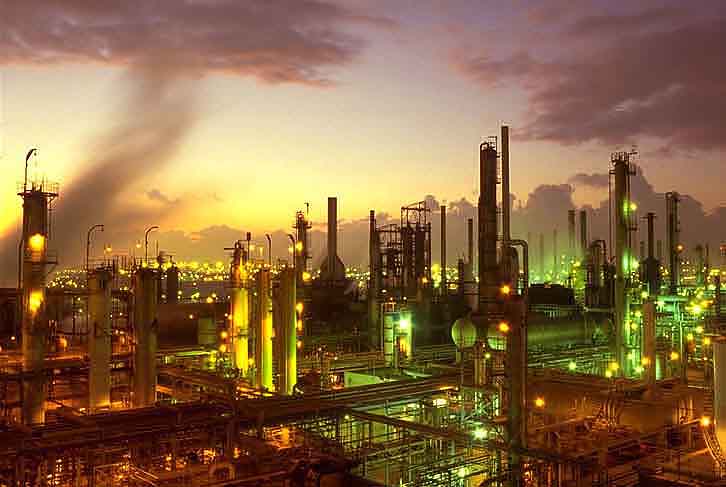
Oil Refinery...

Time to construct: depends... 4, 6, 7 sometimes even 10 years.

Cost: billions a piece

Number in US alone: 132.


Offshore drilling rig

Time to construct: years, depending on size and depth qualification

Rental fee: six-figures a day, going up to $500,000-$600,000.

Oil pipeline

Miles of oil pipeline in US alone: 55,000 of crude oil trunk lines (8-24 inches in diameter), 30,000 to 40,000 of small gathering lines (2-6 inches in diameter).

Mad Matt's guesstimate of replacing global pipeline network: $15 trillion.

Now mind you, even if the world got this rolling next year, it would take decades to complete (something Simmons admits). Simmons is also notorious for claiming oil peaked in 2005 (not according to the EIA, dipshit), and that oil is headed for a crash landing of 60 mbpd by 2015. This means he abides by the 5%, 6.5% annual depletion-rate flavors favored by many doomers (he stated months back that the world's oil fields are declining at annual depletion-rates of 20%, and that only significant investment can bring that down to single digits).

Still, we're going to pretend Simmons is a real Roosevelt, we'll assume we can get this done in 20 years. So, taking last year's total liquids production of 86.17 mbpd, considering Simmons's rhetoric that oil is in decline, and applying a 5% annual depletion-rate to this, we find that... after 20 years, total global production is under 30 mbpd!


It's not half-empty empty, girl. We have a shiny new oil industry for the next fifty years!

So, under Matt Simmons, we managed to squander tens of trillions of ollars, excoriated engineers from practically every vital sector, neglected renewable energy and infrastructure projects, and wasted an asinine amount of steel - all to build a brand new, spanking oil industry that will last us for the next fifty years; even though America, with a current refinery capacity of 17.455 mbpd, wouldn't even need anywhere near that amount under Simmons's apocalyptic future!

In all seriousness... is the oil industry's infrastructure aging? Yes. Is this a concern? Sure; but to the extent Simmons claims? Not even close.

According to the IEA:

Repair of the oil-production facilities built in the 1970s is part of the $6 trillion that needs to be spent by 2030 to meet global oil and gas needs.


Now some critics say the IEA is too stodgy, too out of touch to be reliable. Maybe. But considering Simmons's record of the past few years (I know you debunker aces already have this stuff down, but the mentally-stunted Billy Madisons of the peak oil community are a little behind their special ed. peers, and they need a few "tough love" donkey kicks to their rosey heads to - let's say... - speed them up):

$120-$190 barrel of oil was suppose to hit in 2005.

OPEC currently has no spare capacity.

He stated months back that "the boom of summer 2008 that sent oil and gas prices skyrocketing was the only truly great situation the industry ever had." (the seventies didn't count(?) - oh, and he oddly enough stated the 2008 industry boom wasn't likely to return anytime soon)

Back in 2003, predicted looming gas shortages by 2005; failed to predict shale gas's impact, or the current gas glut; still believes we're going to gas Purgatory.

Throws a conniption about Ghawar's 28% water cut (didn't anyone tell him oil fields typically don't peter out until they cross 50%?).

An oil price crunch is going to hit in a few months (link).

Was featured in the documentary "the Power of Community: How Cuba Survived Peak Oil." (this of course was beautifully debunked by JD)

Even Robert Rapier - a peak oiler, an Oil Drum writer, a fan of Matthew Simmons and somebody I do respect - questioned Simmons's technical expertise in this piece:

I would say that most technical people are familiar with fuzzy logic, so I figured that Simmons was just not a technical guy.

[...]

So, the point is that I am learning to take Simmons with a grain of salt when he is discussing technical subjects. He may be an ace investment banker - and he has certainly made a lot of money - but he has given me no reason to put stock in predictions like this from him: (Rapier goes on to discuss several subjects)

So anywho, what exactly does Mr. Simmons like to say?

“Data always beats theories. 'Look at data three times and then come to a conclusion,' versus 'coming to a conclusion and searching for some data.' The former will win every time.

Indeed, Mr. Simmons. Twighight in the desert, my ass.

- Brewskie

Solar Without the Sun

A cool concept: an energy startup, Cool Energy(!), is working on a solar system that, in theory, could be competitive conventional electricity sources - even in darker climates (link):

The company's system combines a conventional solar water heater with a new Stirling-engine-based generator that it is developing. In cool months, the solar heater provides hot water and space heating. In warmer months, excess heat is used to drive the Stirling engine and generate electricity.

Samuel Weaver, the company's president and CEO, says that the system is more economical than solar water heaters alone because it makes use of heat that would otherwise be wasted during summer months. The system will also pay for itself bout twice as quickly as conventional solar photovoltaics will, he says. That's in part because it can efficiently offset heating bills in the winter--something that photovoltaics can't do--and in part because the evacuated tubes used to collect heat from the sun make better use of diffuse light than conventional solar panels do.

The system is designed to provide almost all of a house's heating needs. But the generator, which will produce only 1.5 kilowatts of power, won't be enough to power a house on its own. The system is designed to work with power from the grid, although the power is enough to run a refrigerator and a few lights in the event of a power failure.

The company's key innovation is the Stirling engine, which is designed to work at temperatures much lower than ordinary Stirling engines. In these engines, a piston is driven by heating up one side of the engine while keeping the opposite side cool. Ordinarily, the engines require temperatures of above 500 °C, but Cool Energy's engine is designed to run at the 200 degrees that solar water heaters provide.


- Brewskie

Natural Gas Fund Hits 27-Year Record (and Other Stories)


Investors are converging like a black cloud of moths on a light: they see that big gas flare above, and they're sinking their greedy teeth into natural gas.
The United States Natural Gas Fund climbed to a historic, record position in its 27-year history; the last of the shares have been snapped up, and investors are awaiting for government approval for more.
From Bloomberg:
The ETF can’t grow further for now because yesterday it ran out of new shares to issue. The ETF asked the Securities Exchange Commission on June 5 for permission to create 1 billion new shares, and is awaiting approval.

John Heine, spokesman for the SEC, said yesterday the timeline for approval varies from case to case.

The fund fell 1 cent, or 0.1 percent, to $12.17 at 12:43 p.m. It’s down 47 percent this year, while natural gas has fallen 40 percent on the Nymex.

“The size of their position is so big that it creates distortions in the market,” said Olivier Jakob, managing director of PetroMatrix in Switzerland. “And that doesn’t mean it just drives prices up. It can also drive prices down.”

On to other things...

Though there has been interest in converting semis, garbage trucks, buses and fleet vehicles to natural gas, natural gas commuter vehicles in the US remains a niche market. To stimulate interest, tax credits for natural gas vehicles may be doubled and extended:

Tax incentives for buying vehicles fueled by natural gas would be doubled in size and extended for a decade under legislation being introduced by U.S. Senate Majority Leader Harry Reid of Nevada.

The credits, which can be used to cover 80 percent of the added cost to buy natural gas-fueled vehicles over conventional automobiles, would jump to as high as $12,500 for passenger cars and light trucks and as much as $64,000 for higher weight-class vehicles, according to a summary of the legislation.

The bill would also expand and extend tax incentives for purchases of natural gas used as a vehicle fuel and for the installation of refueling stations. The credits were set up as part of a broad energy law passed in 2005 to help secure energy supplies and lower costs, issues that are back in the forefront of Congress following record-high oil and gas prices in 2008.

[...]

Refueling-station tax credits would be doubled to as much as $100,000, according to the Senate bill summary. The legislation also includes a provision that would allow businesses to claim 100 percent of the cost of building a manufacturing facility placed in service before Jan. 1, 2015.


Finally, Israel announced it has discovered more natural gas:

A natural gas reserve off the coast of Haifa is larger than first thought.

The Tamar 2 drilling site is nearly 30 percent larger than previously estimated and could reach 180 billion cubic meters, according to prospect partner Nobel Energy Inc., the Israeli business newspaper Globes reported. The value of the field could reach $30 billion.

The new estimate means the reserve could fill Israel's natural gas needs for about 20 years, according to Globes.


Israel's colossal gas find was initially reported here earlier.


Added: Freightliner Trucks just announced a natural gas-powered to its lineup, Freightliner Business Class M2 112 NG.

The company has said that the Freightliner Business Class M2 112 NG truck is its first natural gas-powered truck. The truck is powered by the Cummins Westport ISL G, an 8.9-liter stoichiometric cooled-exhaust gas recirculation engine.

The Cummins Westport ISL G engine is available in rating up to 320hp. The engine features a maintenance-free exhaust system with a three-way catalyst.

Melissa Clausen, director of product marketing for Freightliner Trucks, said: "The M2 112 is a versatile and hard-working truck, and adding a natural gas option only enhances its efficiency. As part of Daimler Truck's shaping future transportation initiative, we will continue to provide reliable trucks with both economic and environmental benefits."


- Brewskie

India's Gas Profile Rising

China's side-kick Asian tiger, "little" India, is a rising economy seen by many as gaining a thirst for oil similar to the leading, and rising protagonist partner. This picture is an envisioned nightmare to envioronmentalists, who fear one day, this car will multiply as if the Hindu Goddess Parvati herself started birthing these out:


India's not a big oil producer (660,000 bpd), but her natural gas production is demonstrating surprise rise. From Business-Standard:

Consider this: While India’s current oil production is around 660,000 barrels a day, that of gas has touched 676,000 barrels of oil equivalent a day. Reliance Industries Ltd (RIL), which has started pumping natural gas from its deepwater discovery in the Krishna Godavari (KG) basin, alone accounts for around 35 per cent of this. Before production from the D6 oilfield at the KG basin started on April 2 this year, the total gas production was 500,000 barrels of oil equivalent a day, which met only 55 per cent of the country’s demand.

P M S Prasad, RIL’s president, petroleum business, said the company was currently producing around 28 mmscmd, which is approximately 176,000 barrels of oil equivalent a day. “Once gas production from the KG D6 reaches the planned production level of 80 million standard cubic metre a day (mmscmd) — about 528,000 barrels a day of oil equivalent — the total gas production in the country would be about 1.5 times domestic oil production,” Prasad said.

This could still be quite a conservative estimate. Former Director General of Hydrocarbons Avinash Chandra said RIL had made several other discoveries in the
same block and as and when they came on stream, the combined output would be
much higher than 80 mmscmd.

[...]

Coal bed methane production by Great Eastern Energy, Essar and ONGC-CIL in Asansol – Durgapur region in West Bengal and in Jharia will also bring a significant change.

Compare this with the crude oil scenario. The projected increase would come only from Cairn’s oil find in Rajasthan besides the MA field of RIL. Rakesh Jain, general manager (Energy) at Feedback Ventures, said the increase in crude oil production was not keeping pace with the gas output. This is a direct result of ageing oilfields and new discoveries being more in gas than in crude oil though the two are found together.

Official figures prove that. Director General of Hydrocarbons VK Sibal, who heads the country’s oil and gas exploration and production regulatory body, said in the production sharing contract (PSC) regime, 106 discoveries had been made
so far, out of which 43 were oil discovery and 63 gas discoveries. These 106 discoveries did not cover the discoveries made by national oil companies in the
nomination blocks.

Going forward, the share of natural gas in the domestic energy basket would continue to rise. “In 2008-09, gas production at 32.481 bcm (214 million barrels of oil equivalent) in the country was marginally less than the oil production at 33.507 million tonne (245 million barrels). However, with gas from deepwaters in the KG basin by RIL, the gas production in the country is expected to exceed the oil production in the current year, Sibal said.

While these are projections, the actual production is a clear signal to the future scenario. The latest figures released by the ministry of petroleum and natural gas show that during the first two months of the current fiscal, domestic crude oil production stood at 40.3 million barrels, with natural gas production only a tad behind at 5.67 billion cubic metre (bcm), translating into around 37.4 million barrels of oil equivalent.

The sharp rise in natural gas production means that the energy consumption scenario is also expected to see a sea-change. The current share of natural gas in India’s total primary energy consumption is currently only 8-9 per cent
compared to the global average of 24 per cent. Prasad cited analyst reports to say that RIL’s 80 mmscmd of gas could lead to 3 per cent savings in India’s import bill.

Analysts said with the country importing 70 per cent of its crude oil requirement of about 100 million tonne, increased production of natural gas would obviously see a change in the user pattern, especially among industrial users. A case in point is the switchover seen in the fertiliser sector. Following the availability of gas from D6, fertiliser companies moved from naphtha, a refinery product derived from crude oil, to natural gas.

- Brewskie

Gensler Wants to Kill the Rats

Oil's 45 cents above $60 at this writing. Regardless, it's been demonstrated that oil speculators, not peak oil, will be humanity's thorn in the future. The masses are fed up with a relative handful of fat rats who pillage humanity's wallet: purchase up paper contracts of oil, without buying the actual asset, and eating their cheese while the working blobs pay up.

The previous Bush administration was clueless with commodities; will the Obama administration fare better? The former Goldman Sachs (one of the biggest beneficiaries of last year's oil drive up) and Treasure Department amigo, Gary Gensler, says he's game:

With the public clamouring for more market regulation, Mr. Gensler was seen as a bad choice to become chairman of the Commodity Futures Trading Commission (CTFC), given his years with Goldman Sachs and at the U.S. Department of the Treasury, where he helped deregulate energy trading.

Mr. Gensler spent five months convincing senators he was up to the challenge and he was finally confirmed in late May. On Tuesday, he backed up his promises by announcing plans for a sweeping crackdown on speculation in energy trading.

The CFTC chairman said he will hold public hearings on whether the CFTC should impose strict limits on the number of contracts energy traders can hold.

The change would radically transform the trading of crude oil, heating oil, natural gas, gasoline and other energy products.

[...]

Mr. Gensler's willingness to look at limiting traders' contracts marks a dramatic shift for the CFTC, which for years had insisted there was no hard evidence that speculators were affecting the price of oil.

Former chairman Walter Lukken, a Republican, had long rejected such suggestions and the CFTC released a report last fall showing that index traders and swap dealers had not significantly influenced the price of oil.

Mr. Gensler has taken the opposite view. He told senators earlier this year that excessive speculation can cause “sudden or unreasonable fluctuations” in commodity prices and he promised a “fresh look at the role of speculation in commodity futures markets.”

He has already launched a review of natural gas trading on the Intercontinental Exchange, or ICE, which operates out of London and is largely unregulated by the CFTC. Meanwhile, Congress is considering legislation that would go even further and tighten regulation of virtually all commodity trading, including swaps, over-the-counter trades and financial products such as credit default swaps.

The CFTC already has broad powers to set so-called position limits in order to prevent price manipulation through corners or squeezes. For example, no trader can own more than 5,000 wheat contracts that expire in the same month.

However, the CFTC has permitted numerous exemptions over the years that have watered down the rules and allowed institutional investors and index funds to hold unlimited amounts. A recent report by a Senate subcommittee concluded that index funds owned up to half of all wheat contracts that traded on the Chicago-based CME Group. That concentration, the report said, was one of the major causes of unwarranted price changes.

The CFTC has also allowed exchanges to set their own limits for energy trading. These so called “accountability levels” have also loosened up over time. For example, the New York Mercantile Exchange officially restricts traders to owning up to 10,000 light sweet crude oil contracts for any one delivery month and no more than 20,000 for all months. But because of numerous exemptions handed out by the exchange, some traders hold more than 300,000 contracts at a time. Since 2006, Nymex has granted 117 exemptions from its levels to index funds, swap traders and others.


Perhaps this will work, perhaps not. Thomas Jefferson said (and I can't remember the exact quote right now) something in the effect that government should not be viewed with adulation, but rather, with a mark of skepticism. Although Obama will no doubt surpass his predecessor (a dog could do that), his approach to tightening the leash on Wall Street's nefarious behavior has been somewhat of a disappointment.

- Brewskie

Wednesday, July 1, 2009

Mass. Seeks to Sieze the Ocean

Massachusetts is building a plan to garner power from different energy sources - offshore wind, tidal and wave farms:

Massachusetts released a draft of a plan Wednesday that would govern the permitting and management of projects such as tidal and wave energy farms.

Touted by the state as the first comprehensive ocean management plan in the country, it aims to support renewable energy and other industrial operations
in the state waters while taking care to protect marine resources, the state
said.

But creating a management plan would help to ensure a more careful planning and permitting process. Other states might follow Massachusetts' step as more renewable energy project developers express an interest in building wind
and ocean power farms up and down the Atlantic and Pacific coasts.

The federal government also has taken steps to set up the regulatory framework, especially because the current administration is keen on promoting renewable energy production and job creation.

The state is now collecting public comments on the plan, and hopes to finalize it by the end of the year.

- Brewskie

Technology Worth its Weight in (Pre)Salt

A Bloomberg article on chewing up salt:

New technology may help companies exploring for oil in the so-called pre-salt area offshore Brazil, home to the largest crude find in the Americas in three decades, Sanford C. Bernstein & Co said.

Most seismic imaging bounces off salt because of its different properties, “meaning that geophysicists are effectively working blind below salt,” Neil McMahon, a London- based analyst at Bernstein, said in a report today. “Oil companies and seismic acquisition companies have started to develop a host of techniques to improve the situation.”

[...]

A lot of the challenges of finding and developing oil in the pre-salt, especially in Brazil, can be put down to rock characteristics, and not just the deepwater environment,” McMahon said. Developments including Petroleum Geo-Services ASA’s GeoStreamer technology may help, the analyst said. That company later this year plans to publish the results of a GeoStreamer survey carried out offshore Brazil, according to McMahon.

“We continue to believe that the exploration in the pre- salt in Brazil is not over,” McMahon said. “The complexity of the geology is becoming a key issue and more wells will be required to complete the pre-salt picture.”


- Brewskie

Halifax Finds Addidtional Shale G... Zzzzz....

Hmm? Oh yeah... Halifax found load boats more shale gas in southern New Brunswick - making the gas reserves much larger than previously thought. Shale gas... 'bout as exciting as seeing a sparrow now days (kidding;))

Shares in a Halifax junior exploration company went up Friday with news that the company’s discovery of shale gas in southern New Brunswick is much larger than originally believed.

Corridor Resources Inc. announced that an independent study carried out in June estimates that 67.3 trillion cubic feet of shale gas is contained at Frederick Brook in the Sussex/Elgin sub-basins.

This is three times the volume expected, according to an analyst’s report.
Shares in Corridor Resources were up 49 cents, or by 20 per cent, in late afternoon trading at $2.89 on the Toronto Stock Exchange.


- Brewskie

And What About Chinese Oil Demand?

(Hat tip: Eric J. Fox)

Stock Market Prognosticator had this snippet on Chinese oil demand. Take an ambien and relax=)

Well so much for demand for Energy from China. This demand growth has always been hyped by Energy bulls, but as I and many others have stated previously, what really matters is demand growth from the the U.S. and other industrialized nations.

Here is how the math works:Oil demand in 2009 for the OECD countries is 45.2 million barrels per day, down 2.3 million barrels per day from 2008.China oil demand is 7.9 million barrels per day. Let's assume that it grows at 5% a year, or about 400,000 barrels per day.

As you can see, the fall in demand from the OECD easily wipes out demand growth from China by a factor of at least five.


- Brewskie